|
The Standard Model of particle physics is remarkably successful in
describing the observed fundamental particles and their interactions
at the level of precision we have been able to probe thus far in
experiments. Despite this, there are several reasons to expect
that it is only the low-energy (long-distance) description of
a more fundamental theory. The Standard Model fails to explain
certain observed experimental phenomena such as the matter-antimatter
imbalance, dark matter and dark energy, and neutrino masses. It also
leaves important theoretical questions unanswered, such as the origin
of the particle masses and mixing parameters. Thus the foremost
goal of the experimental high-energy physics program is to search
for direct and indirect signs of new particles and forces.
Many experiments aim to search for quantum-mechanical effects of
new particles that give rise to tiny deviations from Standard-Model
expectations. Maximizing the new-physics discovery potential of these
high-precision experiments requires reliable and equally precise
theoretical predictions. In almost all cases, the precision
of these tests are limited by our knowledge of the effects of the
strong interaction (QCD) on weak-interaction processes. Numerical
lattice-QCD simulations provide the only method for calculating the
needed hadronic matrix elements and parameters of the QCD Lagrangian
with controlled uncertainties that are systematically improvable.
The objective of USQCD is to bring the lattice-QCD errors down to,
or below, the experimental ones.
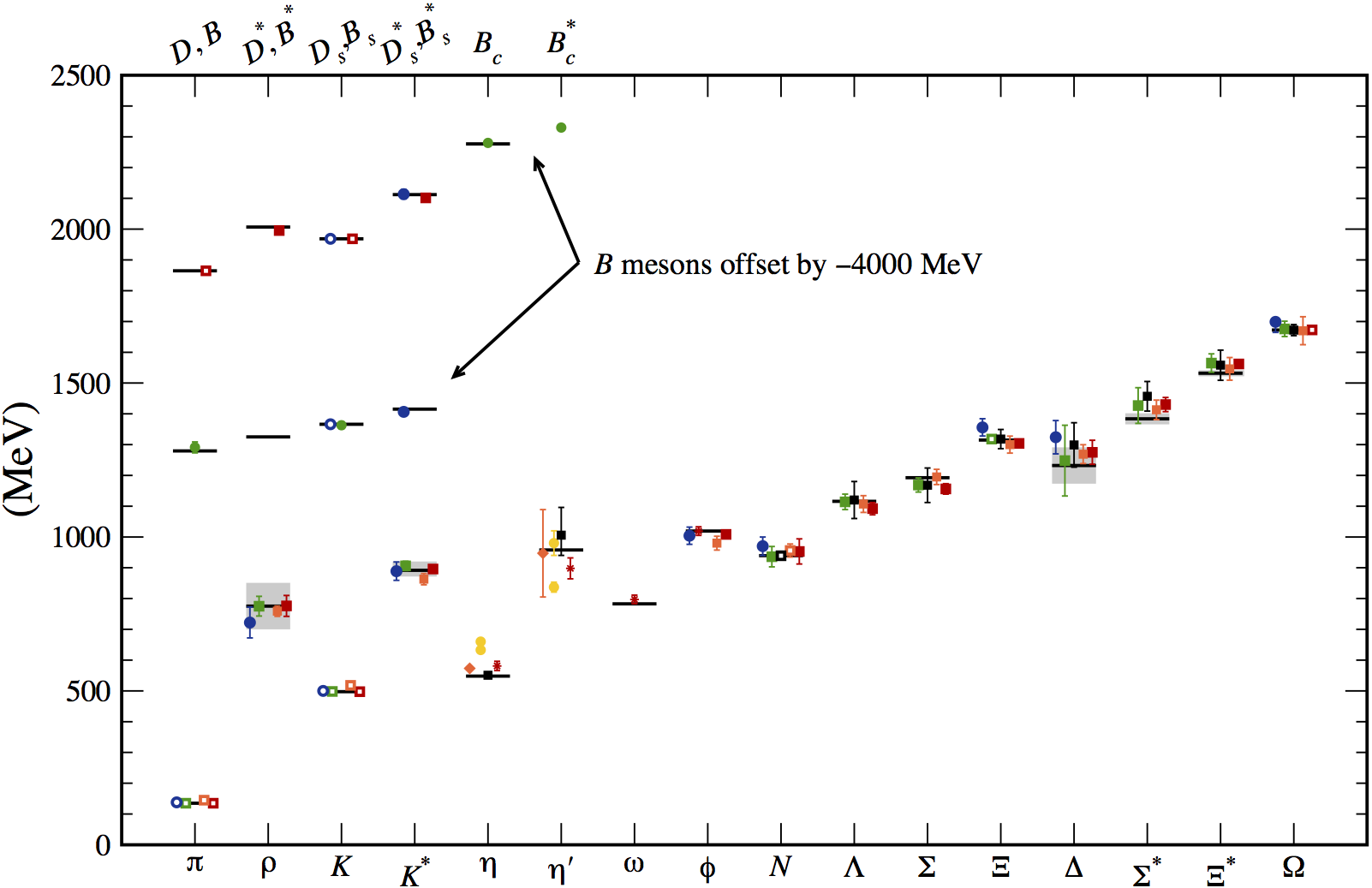
Compilation of lattice-QCD calculations of meson and baryon masses
(update of Kronfeld 2012).
Over the past decade, increased computing power and better algorithms
have led to substantial progress in the lattice-QCD computations of
quantities needed to interpret experimental results in the areas of
particle physics, nuclear physics, and even astrophysics. It is now
standard in lattice-QCD simulations to include the full effects of
vacuum polarization due to light (up, down and strange) quarks, and to
simulate with pion masses close to the value in Nature. Lattice-QCD
calculations successfully reproduce the experimentally-measured
low-lying hadron spectrum, as shown in the figure at right.
Lattice QCD provides the most precise determination of the strong
coupling constant, αs, and competitive
determinations of the charm-and bottom-quark masses. Further,
lattice-QCD calculations correctly predicted the mass of the
Bc meson, the leptonic decay constants
fD and fDs, and the
D → Klν semileptonic form factor
before the availability of precise
experimental measurements. These successful predictions and
postdictions validate the methods of numerical lattice QCD, and
demonstrate that reliable results can be obtained with controlled
uncertainties.
Lattice QCD has matured into a precision tool for quark-flavor
physics. Results with fully controlled errors are available for
nearly twenty matrix elements. By contrast, in 2007, only the
ratio of kaon-to-pion decay constants,
fK/fπ,
was fully controlled.
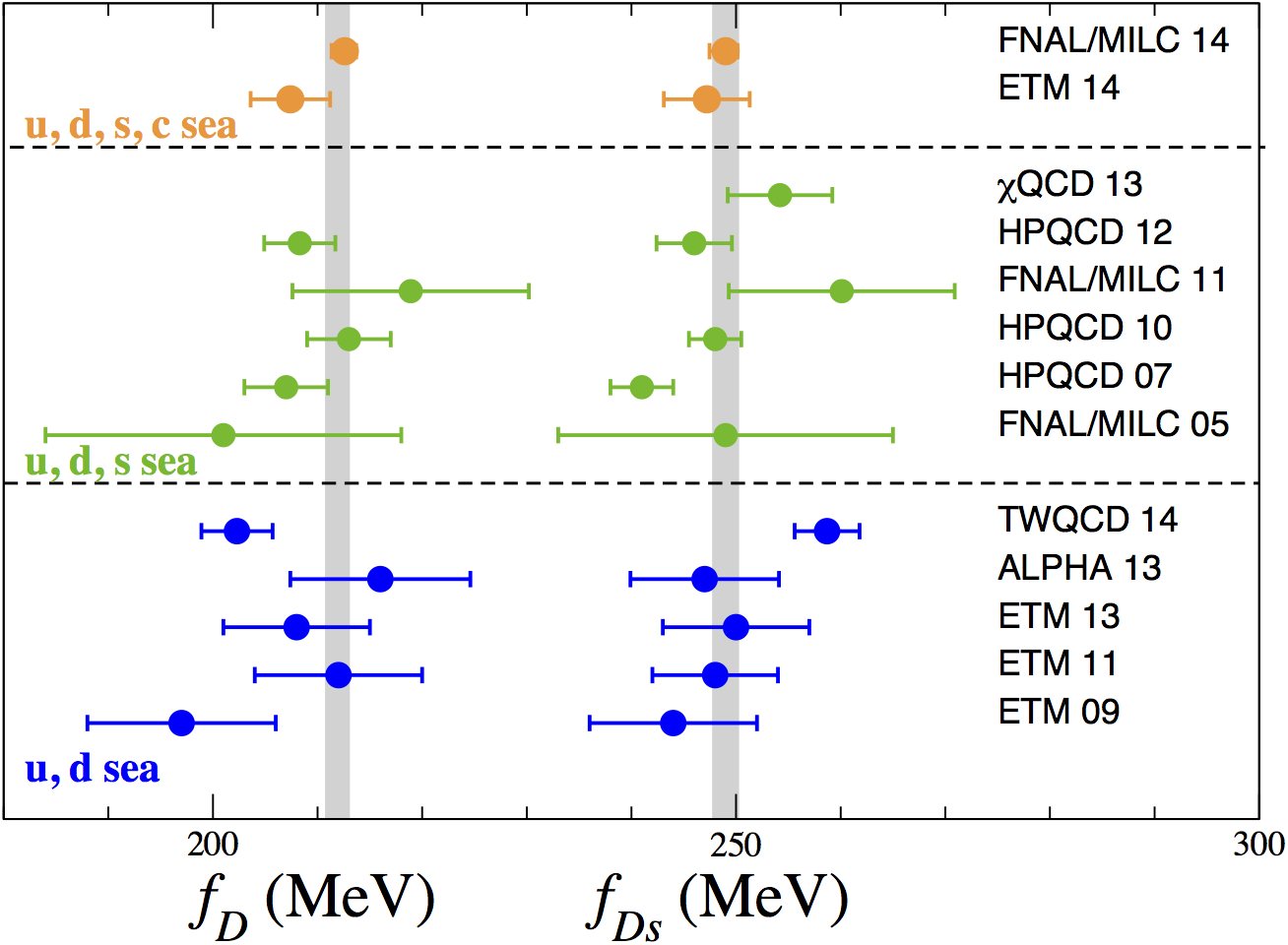
The figure at left shows a recent compilation of lattice-QCD results for the
D- and Ds-meson
decay constants. There are now several calculations with controlled
uncertainties using different lattice quark and gluon actions, which
provide independent confirmation. The most precise calculations
are from USQCD with errors of 0.6% and 0.5% on
fD and fDs,
respectively, use a highly-improved charm-quark lattice action and
include physical-mass pions. In the corresponding determinations of the
Cabibbo-Kobayashi-Maskawa (CKM) quark-mixing matrix elements
|Vcd| and |Vcs|,
the lattice-QCD errors are now below the experimental errors.
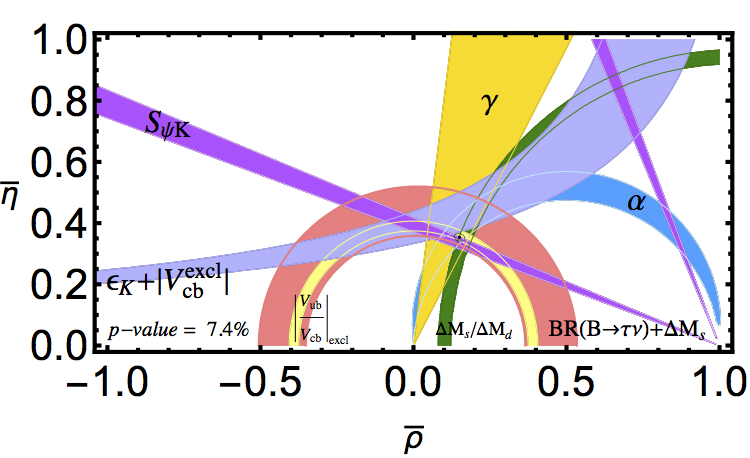
Constraints on the Cabibbo-Kobayashi-Maskawa quark-mixing matrix.
Lattice-QCD calculations are essential to obtain constraints from
neutral kaon mixing (lilac band) and neutral
Bd- and Bs-meson
mixing (green band), and also enable
determinations of the CKM matrix elements
|Vub|/|Vcb|
(bright yellow band). Recent lattice
results have significantly tightened the constraints and increased
the tension between them.
Recently, members of USQCD have produced new lattice-QCD results
for the B → pi and
B → K semileptonic form factors,
the B → Dlν
form factor at nonzero recoil, the ratio of
Λb → Λclν/Λb → plν
form factors, and the neutral
Bd- and Bs-meson
mixing matrix elements. These calculations
led to significant improvements in the determinations of the
Cabibbo-Kobayashi-Maskawa (CKM) quark-mixing matrix elements
|Vub|,
|Vcb|,
|Vtd|, and
|Vts|. The figure at right
shows constraints on the CKM matrix using the
latest lattice-QCD inputs. In this plot, new-physics effects would
show up as inconsistent constraints on the apex
(ρ
,η)
of the unitarity triangle. These recent lattice-QCD calculations
substantially tightened several of the constraints and reduced the
allowed Standard-Model parameter space. They also confirmed and/or
revealed several tensions with the Standard Model of about 2 standard
deviations in the quark-flavor sector.
USQCD is devoting considerable human effort and computing resources
to meet the theory needs of current and upcoming high-energy
physics experiments. Petascale computing is enabling better
simulations with physical-mass pions, very fine lattice spacings,
very large volumes, and dynamical charm quarks, all of which will
lead to increase precision on present calculations. The precision
on simple quantities is approaching the level where strong-isospin
breaking and electromagnetic corrections are becoming relevant.
Simulating with different up- and down-quark masses straightforward.
Methods for are being developed to include electromagnetism in
lattice simulations, and lattice QCD can already reproduce simple
quantities such as the neutron-proton mass difference. USQCD is also
targeting more challenging quantities needed by current and future
experiments. Recently members of USQCD achieved the first complete
QCD calculations of the mass difference between kaon eigenstates,
which is a long-distance amplitude, and of the matrix elements
for K → ππ decays, which has multiple hadrons in the final state.
They also presented the first proof-of-principle demonstration of
a method to calculate the light-by-light contribution to the muon
anomalous magnetic moment (g−2). Continued efforts in developing
new theoretical methods and better algorithms are ongoing. In the
coming decade, anticipated progress in lattice-QCD calculations plus
new experimental measurements will continue to increase the precision
on Standard-Model parameters and sharpen tests of the Standard Model,
hopefully revealing definitive evidence of physics beyond.
|